My Current Investments

Main Labels:

3) AUDSGD (Link for AUD posts)
4) CNYSGD Closed TP 0.208 ( Link for CNYSGD posts)
5) Fullerton SGD Heritage Income Class B ( Link )
6) Global X Uranium ETF Long ( Link )
8) BGF China Bond Fund A6 Hedged (SGD) (Link)
7) US Stock Trade (Link)

Disclaimer :
None of the information contained in this Blog or Video constitutes an offer (or solicitation of an offer) to buy or sell any currency, product or financial instrument, to make any investments, or to participate in any particular trading strategy.

Any expression of opinion (which may be subject to change without notice) is personal to the author and the author makes no guarantee of any sort regarding the accuracy or completeness of any information or analysis supplied.

The author is not responsible for any loss arising from any investment based on any perceived recommendation, forecast, or any other information contained here.

Next Market Crash Stocks Accumulate LIst

Next Market Crash Stocks Accumulate LIst

Intrinsive Value Tracking

Sunday, April 05, 2009

Guru Investor Strategies

Graham :
  • P/E no greater than 15.
  • P/E x P/B not exceed 22
  • Current ratio < 2, less than 2 is utility or telecom
  • Long term debt < Value of the Assets ( Net current assets )
  • Sa;es > 340M
  • 30 to 50% below real value
  • 10 years EPS growth >30%
  • Total debt/equity ratio < 100% , Utilities,phone, railroads <230%
  • Continue Dividend
John Neff :
  • P/E >40% of market average < 60% of market average
  • EPS growth >7%<20%,
  • Futures EPS growth rate >6% current year AND >6% for long term
  • Sales growth > 70% of EPS growth rate, <70% of EPS growth rate but >7%
  • Total return/P/E > ( Market total return/P/E) x2, or > ( Industrial total return/ P/E) x2
  • Free cash flow > 0
  • EPS by quarter ( Q1 most recent q, Q5= 5 q ago), Q1>Q5 and Q2>Q6, and Q3>Q7, and Q4>Q8
David Dreman :
  • P/E in bottom 20% of the market
  • Price/Cash flow ratio in bottom 20% of market
  • Price/Book Ratio in bottom 20% of market
  • Price/Dividend Ratio in bottom 20% of market
  • Market cap among 1,500 largest publicly traded stocks
  • EPS Q1 >EPS Q2
  • EPS growth in the immediate past and future, EPS growth from Q3 to Q1 > S&P 500 growth Q3 to Q1 and projected growth for this year > S&P 500 growth for this year
  • Current ratio > Industry average or > 2
  • Payout ratio < average historical payout ratio
  • ROE > 27% or top third of 1,500 largest -cap stocks.
  • Pre tax margin > 22% to 8%
  • Yield > Dow yield +1 %
  • DEbt to Equity ratio =0 but <20%
Warren Buffet:
  • Earning Predictability ( Y1 most recent years, Y10 10 years ago), Y1>Y2>Y3>Y4...Y10 and no years with negative EPS ( A dip from a prior year's earning that no more than 45% , also acceptable but o years negative EPS)
  • Long term debt < 2 times earning or <2 < 5
  • ROE ( Average over the last 10 years) > 15%
  • Return on Total capital ( ROTC ) > 12%
  • FCF >0
  • Utilization of RE, return of Retained Earning > 15% or >12<15%
  • Initial Rate of Return ( Earning Yield ) = EPS/P, > long term T-bond yield)
  • Return on equity >15% or >12<15%
  • EPS growth >15% or >12%<15%
  • Average final return ( Expected ROE+ Expected EPS)/2 >15% or >12%<15%
Peter Lynch:
  • PEG and Yield adjusted PEG>0<0.5 or >0.5<1
  • Change in Inventory , financial or Service Co not applicable,change in inventory/sales is negative or zero or positive but less than 5
  • Total debt-Equity ratio financial or Service Co not applicable,D/E < 30%, or >30<50%, or >50<80%
  • For Financial stocks : Equity to Asset Ratio > 5% or >13.5%. ROA > 1%
  • P/E for fast Growers, Sales >$1 billion and PE < 40
  • EPS growth for fast growers > 20<25% or >25<50%.
  • Stalwarts ( Earning growth 10 to 20% and annual sales $2billion or more ). EPS >0
  • Yield > S&P yield and > 3%
  • Bonus Criteria: FCF to Current ratio > 35%
  • Net Cash per share to Current Ratio >30<40% or >40<50
Kenneth L Fisher:
  • Price/Sales Ratio, Noncyclical and Tech stcoks : PSR < 0.75, PSR >0.75<1.5 are good vale. Cyclical stocks : PSR <0.4. > 0.4<0.8 are good value.
  • Total debt/equity ratio <40%
  • Price/Research Ratio <5 best, >5<10 Pass, >10<15 ok.
  • Price/Sales for super stock, Noncyclical and Tech <0.75, Cyclical <0.4
  • Inflation adjusted EPS growth > 15%
  • FCF > 0
  • 3 years ave net Profit Margin > 5%
Martin Zweig:
  • PE Ratio >5 and <43 and <3x Market PE
  • Revenue growth >85% of EPS growth or Revenue growth > 30% per year
  • Current EPS >0
  • EPS for quarter one year ago >0
  • Growth from Q1 to Q5 >0
  • Annual Earning Persistance , Y1>Y2>..Y5.
  • Earning growth for past 4 quarter compare with previous year quarter must > 50%
  • Long term EPS growth > 15 Pass or > 30% best case
  • Growth Q5 to Q1 >30% and > Historical growth rate
  • D/E < Industrial average
  • Insider sell = 0 AND buy > 3
James O' Shaughnessy
  • Market Cap >$ 150M
  • EPS Persistance , Y1>Y2>.....Y5
  • PSR <1.5
  • In top 50 stocks of passing the three criteria
Value Strategies
  • Market Cap >$ 1billion
  • Cash flow per share > Market average cash flow/share
  • Share outstanding > Market average shares outstanding
  • Trailing 12-Month sales > ( Market average sales (TTM)) x 1.5
  • Dividend Yield in top 50 passing the previous four criteria
Joel Greenblatt:
  • Determine Return on Capital ( Earning before interest and taxes)/(Net working capital + Net Fixed asset)
  • Determine Earning Yield ( Earning before interest and taxes)/( Enterprise value)
  • ROE + EY among 20 lowers of eligible stocks
Joseph Piotroski:
  • B/M in top 20% of market
  • ROA >0
  • ROA most recent year>ROA previous year
  • CF>0
  • CF from operation > Net income
  • LTD/A for most recent year < previous year
  • CR recent year> previous year
  • Number of share outstanding in most recent year < previous year
  • GM recent > previous year
  • Asset turnover recent > previous year
Blogged with the Flock Browser

Saturday, March 21, 2009

Gauging the Turn in Dollar, Gold and Oil

Technically, the ensuing positive correlation between the USD and global equities suggests an acceleration of the dollar sell-off as equities extend their recovery (albeit still deemed a bear market bounce). Indices would have to rally by more than 27%-28% from this months lows to 845-855 in the S&P500, 4,460-4,500 in the FTSE-100, 4,680-4,700 in the Dax-30 and 9,000-9,100 in the Nikkei-225.
Safe Haven | Gauging the Turn in Dollar, Gold and Oil
Blogged with the Flock Browser

Thursday, March 19, 2009

Reflation Investing - Which Currencies Benefit?

Not surprisingly, gold has been a main beneficiary of the trends we see. Because industrial activity is likely to lag in this "recovery," gold being a precious metal with low industrial use, is a barometer of the money being printed. As reflationary efforts take hold, the money is likely to flow to other commodities - we see trends of that already - before possibly reaching corporate earnings. The Australian dollar is highly correlated with the price of gold; we like the Australian dollar as a reflation play because the Australian economy is highly sensitive to the price of commodities; Australia is also a large exporter of commodities to China, the one country that can afford its stimulus plan. Australia is fiscally in much better shape than the U.S., although it also has a high current account deficit. That current account deficit worked against the Australian dollar when commodity prices imploded, but may cause the Australian dollar to have a more pronounced upward move as the world reflates. We like Australia's smaller neighbor New Zealand, especially because the government there has had much more of a hands off approach to the global crisis; as a result, similar to Australia, the New Zealand dollar was harder hit during the downturn, but may benefit at an above average rate in a reflationary phase.
Safe Haven | Reflation Investing - Which Currencies Benefit?
Blogged with the Flock Browser

Saturday, February 28, 2009

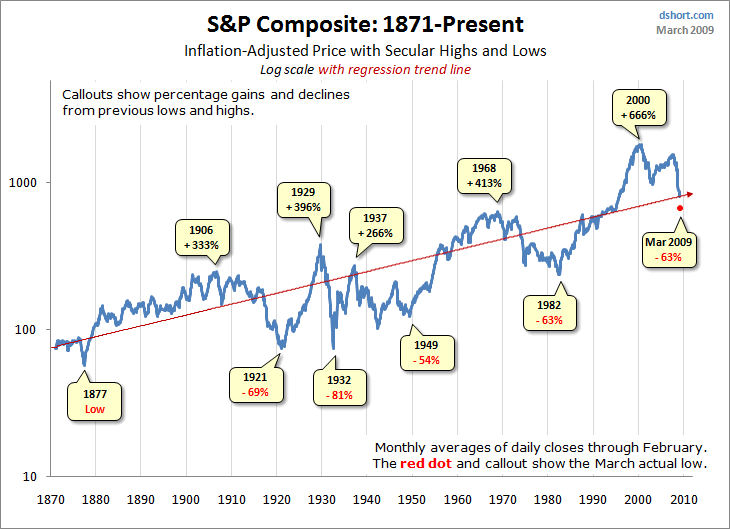
Bear Market Recoveries Since 1950

dshort.com: Bear Market Recoveries Since 1950
Blogged with the Flock Browser

Unemployment-SP-Composite-since-1948


http://www.dshort.com/charts/unemployment-SP-Composite-since-1948-large.gif
Blogged with the Flock Browser

Bear-markets-comparison


http://michaelcovel.com/images/bear-markets-comparison-xlrg.gif
Blogged with the Flock Browser

The Final Currency To Top Out

When the rest of the world gets fewer dollars from a shrinking trade deficit, the value of the Dollar strengthens. The US now is embarking on a path to an astronomically high budget deficit that will have the complete opposite effect. Instead of foreigners being flush with Dollars to re-invest in the United States, they are lacking Dollars at the very time that we need their Dollars the most - to fund the US government's deficit. This can only have one effect on the Dollar - that is for it to FALL.The US Dollar should have been falling during the last 18 months as interest rates were slashed and our fundamentals were the worst in the world. Common sense always prevails, and anyone still expecting the Dollar to remain strong and deflation to be headline news is going to be shocked.
Safe Haven | The Final Currency To Top Out
Blogged with the Flock Browser